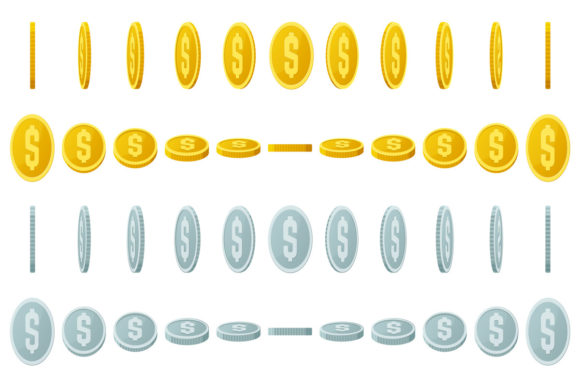
The Visual Psychology of Realistic Falling Coins
In a world saturated with digital imagery, certain visual motifs transcend simple decoration and tap directly into subconscious associations. Among these, the dynamic, three-dimensional depiction of coins cascading into a pile stands out as a particularly potent graphic. This isn't merely an animation or a static icon; it's a symbol loaded with meaning, engineered to evoke specific feelings and convey messages without a single word.
Why a Falling Collection of Coins Captures Attention
The human brain is wired to respond to movement, accumulation, and symbols of value. A graphic featuring realistic falling coins combines all three. The motion implies activity, growth, and arrival—something is happening, and it’s profitable. The three-dimensional realism gives it tangibility; these aren’t flat cartoons but objects with weight, texture, and sheen, making the success they symbolize feel more concrete. The bundling up in the center creates a focal point of abundance, a visual climax that satisfies our innate desire for gathering and reward.
This imagery works on a level deeper than conscious thought. It triggers associations with luck, financial gain, achievement, and celebration. For businesses and creators, leveraging this pre-existing psychological shorthand can communicate complex ideas instantly. It tells a story of progression from effort to result, visualized as individual units coalescing into a collective prize.
Core Characteristics of Effective Coin Graphics
Not every coin graphic carries the same impact. The most effective ones, like the described realistic falling coins bundle, share distinct characteristics. First is high-quality three-dimensional rendering. Each coin should possess believable light reflection, edge definition, and perhaps even slight imperfections, moving away from sterile digital perfection towards something that feels real. Second is dynamic, natural motion physics. The fall should appear governed by gravity, with coins tumbling and rotating independently, not sliding down in unison. Finally, the composition must build towards a satisfying central accumulation. The pile isn't chaotic; it's the destination, the goal, the visual proof of the process.
Primary Applications Across Industries
The versatility of this graphic stems from its core message of value accumulation. Its application extends far beyond a single niche.
- Casinos and Gaming Platforms: Here, the direct link to winning, jackpots, and slot machine payouts is unmistakable. It serves as an immediate reward cue in app interfaces, promotional materials, and loyalty program dashboards, heightening the sense of potential gain.
- Business and Finance: For fintech apps, investment platforms, or corporate presentations, it visualizes growth, ROI, profit stacking, and quarterly results. It transforms abstract financial data into an intuitive, motivating picture.
- Educational and Training Resources: Educators teaching economics, mathematics, or even game theory can use such graphics to illustrate concepts like aggregation, cumulative interest, or resource collection in simulations and instructional videos.
- Marketing and Advertising: Any campaign centered on savings, earnings, discounts ("save your coins"), or customer rewards can employ this imagery to anchor its promise. It’s a metaphor for the benefit awaiting the consumer.
- Hobbyist Projects and Indie Games: Developers creating resource-management games, strategy sims, or even digital art projects find these graphics invaluable for representing in-game currency, loot drops, or achievement unlocks.
The Technical Asset: From EPS10 to Preview
For professionals implementing this visual, the technical delivery matters. A package containing an EPS10 file and a 72ppi JPEG preview represents a practical workflow. The EPS10 vector file is the cornerstone. This scalable format allows designers to resize the graphic infinitely without quality loss, integrate it into larger compositions, or even modify elements like color or individual coin paths within vector editing software, ensuring flexibility for brand adaptation. The accompanying 72ppi JPEG preview serves a crucial administrative function: it’s a fast-loading, easy-to-view reference for selection, approval, and placement in early-stage mockups before the final vector asset is embedded.
Strategic Advantages Over Generic Imagery
Choosing a specialized graphic like a realistic coin fall over a generic money icon offers tangible strategic benefits. It provides contextual specificity. A single coin icon might mean "price" or "currency," but falling coins explicitly mean "accumulating money," "winning," or "growth." This reduces cognitive load on the viewer. It also enhances emotional resonance. The dynamic nature and realism create a mini-narrative, fostering a more engaging and memorable connection than a flat symbol. Furthermore, it supports brand differentiation. In crowded markets like gaming or fintech, using distinctive, high-quality motion graphics can elevate a brand's visual identity above competitors using stock imagery.
Considerations for implementation are straightforward but important. The graphic must align with the overall visual tone of the project—a hyper-realistic coin bundle might clash with a minimalist, abstract design language. Also, its use should be contextually honest; employing it to represent gains where none exist can feel manipulative. The goal is to visualize a true process or potential, not to fabricate one.
Observations on Modern Visual Communication Trends
The rise of such assets reflects a broader trend in digital communication: the move towards kinetic symbolism. Static infographics and icons are giving way to short, looping motion graphics that explain processes, show cause-and-effect, and symbolize outcomes. A realistic falling coins graphic fits perfectly within this trend. It’s a kinetic symbol for the outcome of success. This aligns with how users consume content today—quickly, on screens, expecting visual stimuli that convey meaning efficiently. For educators explaining economic principles or researchers presenting data on wealth distribution, this type of graphic can serve as a powerful, repeating visual motif in presentations or online publications.
Integrating the Graphic into a Creative Workflow
For a designer or content creator, integrating this element is a matter of purposeful placement. It can act as a hero visual on a landing page for a savings app, dominating the screen to set the theme. It can serve as an animated transition element in a video, appearing as a financial milestone is discussed. In UI design, a smaller, simplified version might animate as a user completes a task or earns a reward, providing immediate visual feedback. The key is to let the graphic’s natural narrative—the fall and the pile—mirror the user’s journey or the system’s function.
Examples in the wild are increasingly common. One might observe it in the background of a treasurer’s annual report video, subtly reinforcing the message of fiscal health. Or, in a mobile game, a burst of falling coins might accompany the completion of a high-level challenge, delivering a visceral sense of accomplishment far beyond a simple points notification.
The enduring relevance of the realistic falling coins graphic lies in its fundamental alignment with universal themes of effort and reward. By choosing a high-quality, thoughtfully implemented asset, professionals across fields—from business owners to app developers to educators—can harness this alignment to communicate, motivate, and explain with exceptional clarity and impact. It transforms the abstract concept of "success" into something one can almost hear and feel, a visual currency of achievement.