The Visual Language of Smart TV Technology
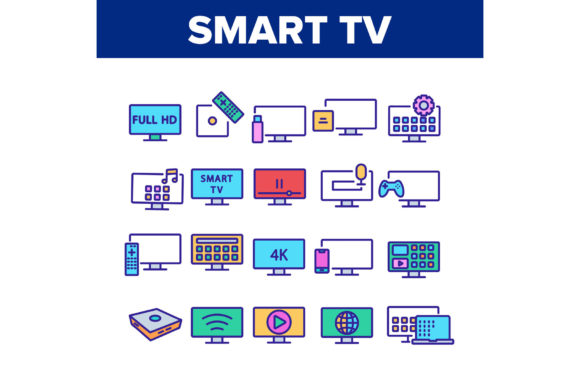
In the digital age, communication is often reduced to symbols. We navigate complex interfaces, understand device capabilities, and conceptualize entire ecosystems through simple pictograms and icons. This visual shorthand is crucial for making advanced technology accessible. When considering the modern smart television landscape, a collection of linear icons—like a Smart Tv Television Collection Icons Set—serves as a foundational visual vocabulary. It distills the multifaceted world of streaming, connectivity, resolution, and gaming into clean, understandable forms.
Decoding the Linear Pictogram
A linear icon set, typically offered in formats like JPG for immediate use and EPS for scalable vector editing, is more than just a graphic asset. It is a system of meaning. Each thin, continuous line represents a key function or concept. For a smart TV, these might include icons for Wi-Fi connectivity, app shortcuts, screen mirroring, voice control, or a game controller. The “linear” style, with its emphasis on simplicity and outline, inherently suggests clarity and modernity, aligning perfectly with the sleek design of contemporary televisions.
This visual system helps bridge the gap between technical specification and user intuition. Before a consumer even reads about a TV’s “HDR10+ support,” they might see a corresponding brightness or contrast icon in a product brochure. Before a developer documents an API for a TV’s smart platform, they might use a standardized set of icons in their UI mockups. The Smart Tv Television Collection Icons Set Vector provides this standardized toolkit, ensuring visual consistency across manuals, websites, retail displays, and software interfaces.
The Core Concepts Encoded in Icons
Analyzing a comprehensive icon set reveals the pillars of today’s TV technology. Several key categories always emerge.
- Resolution & Picture Quality: Icons for Full HD, 4K Ultra HD, and even 8K are central. These aren’t just numbers; they are often represented by symbols denoting crispness, detail, or a mountain landscape with extreme clarity. They communicate the leap from standard definition to the immersive detail where individual leaves on a tree or textures on a game character become visible.
- Connectivity & Ecosystems: Pictograms for Bluetooth, casting, LAN ports, and HDMI arcs are vital. They visually explain how the TV becomes a hub, not just a display. An icon showing a phone sending a signal to a TV instantly explains screen mirroring. A series of connected device icons illustrates the concept of a smart home hub.
- Content & Applications: Linear icons for streaming service logos (abstracted), web browsers, media players, and cloud storage depict the TV’s shift from a broadcast receiver to an internet portal. They signify access to a world of content beyond traditional channels.
- Gaming & Performance: With TVs now as critical for gamers as monitors, icons for high refresh rates (e.g., 120Hz), gaming mode auto-switch, and specific console compatibility are essential. A simple controller icon paired with a lightning bolt can efficiently convey “low-latency gaming mode.”
From Vector Files to Real-World Understanding
The practical utility of these icon sets spans numerous fields and user groups. For the professional graphic designer creating a retail catalog, the EPS vector format is indispensable. It allows them to scale icons to any size without loss of quality, integrate them into complex layouts, and modify colors to match brand schemes for a product lineup featuring Smart Tv Electricity Technology. For the educator or researcher explaining the evolution of home entertainment, these pictograms serve as clear visual aids in presentations or papers, breaking down technical jargon into universally recognizable symbols.
For the consumer or hobbyist, encountering these icons in user manuals or on-screen menus directly enhances their practical understanding. A well-designed icon set can reduce the learning curve for a new TV’s features. When a user sees a familiar “network” icon next to a new “AI upscaling” option, it creates a mental association that the feature is related to processing streamed content. This builds real-world relevance directly into the user interface.
Implementing Icons in User Experience Design
One of the most critical applications is in the TV’s own software. The on-screen menu system relies heavily on iconography to navigate vast options. A thoughtfully designed set, following principles of clarity and consistency, can make navigation intuitive. Poor or inconsistent icons lead to frustration. Consider the difference between a generic “settings” gear and a specific icon for “audio output settings” that depicts a sound wave exiting to external speakers. The latter provides immediate context, fulfilling the Helpful Content principle by anticipating the user’s need for quick, accurate comprehension.
Business owners, particularly in the tech retail and marketing sectors, use these collections extensively. A promotional banner for a new TV model will use icons for its key selling points: a 4K icon, a gaming controller icon, and a voice assistant microphone icon. This allows for a compact, visually-driven advertisement that highlights characteristics and advantages faster than text alone. The icons act as visual proof points.
Characteristics of Effective TV Technology Iconography
Not all icon sets are equally useful. An effective Smart Tv Television Collection Icons Set possesses specific characteristics. First, it must be semantically precise. An icon for “HDR” should differ meaningfully from one for “brightness adjustment.” Second, it requires stylistic consistency. All icons should share the same line weight, corner radius, and visual metaphor style (e.g., outline vs. filled) to be perceived as a coherent system. Third, it needs cultural and contextual relevance. A “streaming” icon might evolve from a simple play button to a more abstract cloud-and-play symbol as the concept becomes more sophisticated.
The choice between JPG and EPS formats, often both provided, addresses different use cases. The JPG is ready-to-use for quick digital placement, ideal for web articles or simple presentations. The EPS vector file, however, is for professional implementation where scalability and editing are required. This dual offering maximizes the set’s applicability across different projects and expertise levels.
Observing Trends Through Icon Evolution
The evolution of what appears in these collections itself documents technological trends. Earlier sets might have emphasized physical inputs like composite video or SCART ports. Modern sets, reflecting the current Gaming And Video Device Concept, highlight wireless features, AI processing, and integration with other smart devices. The emergence of an icon for “IoT hub” or “energy saving mode” in a TV icon set speaks to the television’s expanding role in home management and ecology. Observing these changes provides a unique lens on industry direction.
Furthermore, the aesthetic of these icons has shifted. The move towards linear, minimalist pictograms reflects a broader design trend favoring cleanliness and space. This also parallels the physical design of the TVs themselves—thin bezels, sleek stands. The visual language of the icons and the product design are in harmony, reinforcing a brand’s or industry’s commitment to a streamlined, user-focused experience.
Considerations for Creators and Professionals
When utilizing such an icon set, several considerations ensure effective communication. Overuse can lead to visual clutter; icons should support text, not replace it entirely. Context is key: the same “wireless” icon could mean Wi-Fi, Bluetooth, or casting depending on its placement and accompanying label. It’s also vital to ensure the set is inclusive and understandable across different demographics. An icon representing “voice search” should be clear to both a tech-savvy young adult and an older user adopting smart technology for the first time.
From an SEO and content creation perspective, these icon sets provide a tangible anchor for discussing abstract topics. An article about 4K technology can be visually grounded by referencing or depicting the standard 4K pictogram. This satisfies the E-E-A-T (Experience, Expertise, Authoritativeness, Trustworthiness) principle by demonstrating a clear, knowledgeable use of industry-standard visual tools to explain concepts. The keywords—like Smart Tv Television Collection Icons Set Vector or Full Hd And 4k—are woven naturally into the discussion of their practical application and meaning, optimizing for informational search intent without forced repetition.
Ultimately, a collection of color illustrations and linear pictograms for smart TV technology is a map. It maps the functional terrain of a powerful and complex device. For the professional, it’s a tool for creating clearer communications. For the consumer, it’s a guide to unlocking their device’s potential. For the industry observer, it’s a record of technological priority and evolution. By understanding this visual language, one gains a more practical and thorough understanding of the smart TV itself—not just as a piece of hardware, but as a dynamic node in our digital lives.